It takes only a bit of courage to solve traffic jams in Belgium. Proposed remedies to traffic jams are: “more public transport”, “free public transport”, “green cars”, “tax-per-kilometer”, “more bike-lanes”, etc. The most absurd proposition “extra lanes on highways” simply ignores the fundamental law of road congestion: New roads will create new drivers, resulting in the intensity of traffic staying the same. All the proposed remedies come at high cost and with a marginal improvement of overall mobility.
Our political representatives so far kept ignoring the “best and only” solution. Is it due to demagogy or ignorance? This solution will be accepted by the voters, will contribute to the state budget, will improve the environment and can be implemented (almost) overnight.
Given we voted at the regional and federal level last year, we have 4 years to solve the traffic problem. In this short memo, I lay out what is congestion pricing, how it works and why people (will) love it. Yes, congestion pricing is the best and only solution to solve traffic pain.
1. What is congestion pricing?
Congestion pricing is a system of surcharging users during peak hours to reduce traffic congestion. Think about airlines charging higher fees for airport slots at busy times (7-9am). Think about holiday resorts charging customers more during the Christmas period. Advocates claim this pricing strategy regulates demand, making it possible to manage congestion without increasing supply.
Concretely, congestion pricing for cars willing to enter a city (like Brussels) could work like this in the week:
– before 6.30 = free
– 6.30 – 7.00 = 2€
– 7.00 – 7.30 = 3 €
– 7.30 – 9.30 = 4€
– 9.30 – 16.00 = 2€
– 16.00 – 17.00 = 3€
– 17.00 – 19.00 = 2€
– 19.00 – 19.30 = 1€
– 19.30 – … = free
2. Why does congestion pricing work?
Congestion pricing works because it directly influences people’s decisions in a way that reduces traffic for everyone. Let’s take two coworkers: instead of driving separately and each adding a car to the road, they decide to carpool, cutting the number of vehicles in half. Retired individuals, who don’t have the same time constraints, might choose to delay their trips, avoiding the peak traffic hours. These small changes can have a big effect on congestion.
For busy professionals, paying a small fee—let’s say 2 to 5€—to save one hour in traffic could be a no-brainer. Many people would gladly pay that to avoid wasting precious time sitting in a jam. The key here is that congestion pricing doesn’t force everyone to change; it simply provides an incentive for those who are willing to make a small adjustment.
Studies show that removing just 20% of cars from the roads can significantly reduce congestion. This doesn’t require drastic changes or expensive infrastructure—just a smart, targeted pricing strategy that encourages people to make better decisions. It’s a practical solution that gets results without a huge financial or societal cost.
3. How to get voters support?
The real problem for politicians? Voters. Nobody wants to pay for something that was previously free, even if it would be in their best interests to do so.
Stockholm (Sweden) has shown more than 10 years ago how one best gets voters’ support.
- First, implement the congestion pricing scheme for a test period of 6 months. Make sure there is ample communication and that potential glitches (like a loophole in the maze or failed pricing) are tackled in a very reactive way. If you want to play it safe, introduce the congestion pricing scheme at the same time as the opening of a new metro line, a new tunnel (Oosterweel – Antwerp) or bike bridges.
- Second, after 6 months, stop the congestion pricing scheme. Pick a peak moment, like October or March (traditionally busy months on the road).
- Third, two weeks after the end of the congestion pricing scheme, hold a referendum. I bet my money that voters will massively approve the congestion pricing scheme!
Still not convinced? Look at Paris. The mayor Anne Hidalgo didn’t introduce congestion pricing but she transformed the city by building bike lanes, increasing car parking and introducing parking fees for scooters. The results are far from perfect and many people are rather vocal. Voters’ reality? She was easily re-elected. The silent majority won by a landslide.
While practical details (fees, tax, green cars, perimeter, etc.) need to be fixed, a congestion charge in and around Brussels (and Antwerp) is the only solution to the traffic problem that will be accepted by the voters, that will contribute to the state budget, that will improve the environment and that can be implemented (almost) overnight.
4. New York has done it in 2025, and it works
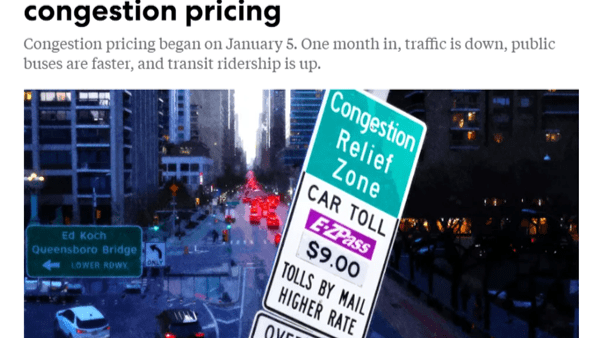
Still not convinced? Look at New York. The city installed a congesting pricing scheme early 2025. The first data for New York City’s new congestion pricing program shows that gridlock lessened in its initial week as fewer drivers travelled into the core of Manhattan, though traffic continued to be heavy in parts of the tolling zone.
The scheme at New York:
- Passenger cars face a $9 toll during peak hours, from 5 a.m. to 9 p.m. on weekdays and 9 a.m. to 9 p.m. on weekends, and a $2.25 toll overnight.
- Tolls are more expensive for commercial traffic, and vehicles without E-ZPass face a 50% premium.
- The charges are meant to reduce traffic in the city and also raise funds for $15 billion worth of transit repairs to the MTA.
5. Congestion pricing flywheel
Introducing congestion pricing unlocks a flywheel of benefits. First, busy people save a lot of time (and money). Wouldn’t you gladly pay 5€ to save 1 hour of commute? Second, people living in areas impacted by traffic experience calm in their streets. Third, the state budget benefits at least four times (in the range of € 10 to 20 Bn for a 11M people country like Belgium): 1) Congestion pricing revenue. 2) Additional productivity. 3) Reliable logistics and additional attractiveness for the region. 4) More time for consumers to spend. Finally, Mother Earth thanks us.

Very honestly, I struggle to see any rationale counterargument to testing the system in 2026. The system could be deployed in a few months using existing cameras in most Belgian cities.
–
Disclaimer: I mostly commute by bike.
Source:
https://www.ft.com/content/c229b603-3c6e-4a1c-bede-67df2d10d59f
 Miguel's Notes
Leave a comment