Breaking the Filtered Feedback Loop: What Every CEO Needs to Hear (But Often Doesn’t)
As a CEO, you’re expected to be the visionary: the one who sets the direction and sees what others don’t. But there’s a paradox: the higher up you are, the less true feedback reaches you. People filter what they tell you, sometimes to protect themselves, sometimes to protect you.
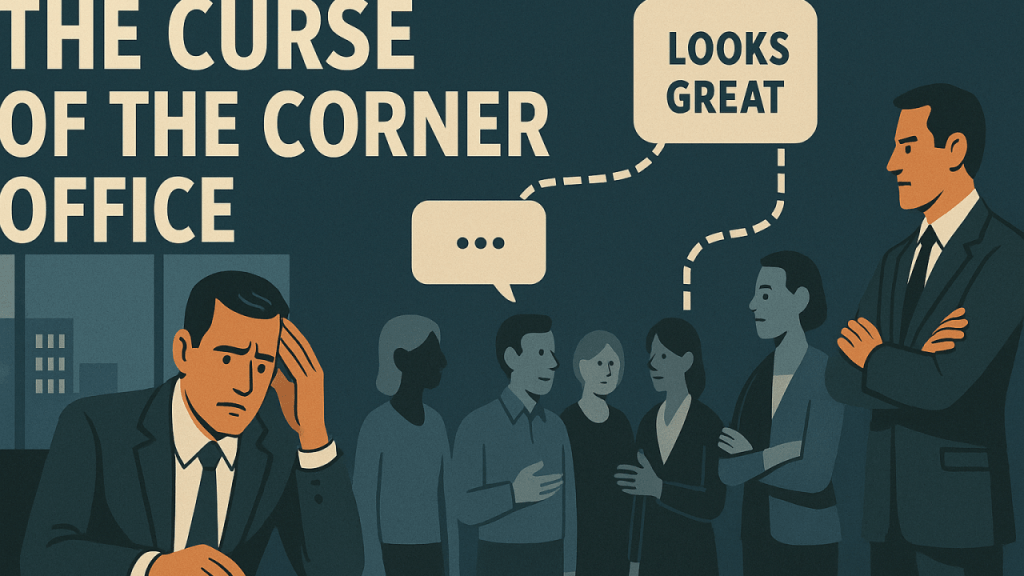
This is the filtered feedback loop: a trap where information gets blurred as it moves up the chain. Criticism is softened. Risks are understated. Disagreement gets replaced by polite nodding. Over time, you’re not leading based on reality, you’re leading based on false beliefs.
What is the filtered feedback loop?
It’s what happens when people tell you what they think you want to hear. When your team hesitates to challenge you. When updates are wrapped in optimism and key details are left out. It’s not with bad intentions, it’s human nature. But it creates blind spots.
The symptoms are:
- Surprise client churns (“I had no idea they were unhappy.”)
- Strategic failures (“Why didn’t anyone raise this sooner?”)
- Groupthink in meetings (“Everyone seems to agree.”)
- A culture of surface-level alignment (“We say we’re aligned, but we’re not.”)

Why it’s more dangerous than ever
The pace of change has never been faster. Markets shift overnight. Customer needs evolve constantly. Technology moves at unprecedented pace. If you’re not hearing the real story, from the front lines, from your clients, from your people, you’re steering blind. And by the time you realise it, it might be too late.
How to break the loop
A few principles CEOs can apply to break the filtered feedback loop.
– Design for dissent
Actively invite pushback. Ask questions like: “What are we ignoring?”, “What would you do differently?”, “If this fails, why will it fail?” Then listen without reacting defensively.
My secret trick? Ask for ADVICE instead of feedback. People will intuitively be careful when asked for feedback, but open up when one asks for advice.
– Flatten your information flow
Don’t rely solely on reports and dashboards. Be on the floor and talk to the front lines. Hold open Q&A sessions. Use tools where feedback can be shared directly and anonymously if needed.
– Reward reality, not agreement
When someone challenges a decision and brings a better idea, spotlight it. Show that disagreement, when done constructively, is a strength, not a threat.
– Show vulnerability first
If you want unfiltered input, model it. Use sentences “I was wrong” or “I’m not sure about this”. You’ll be surprised how much that opens the door for others to be honest too.
How we’re tackling it at BrightWolves
Internally at BrightWolves, we run anonymous employee pulse surveys where we welcome any ideas and suggestions. We also make sure our leadership team is actively involved in client projects and iterates daily with our consulting teams. Every quarter, we also NPS surveys for a select group of clients.
For our clients willing to break the filtered feedback loop, we assist them by conducting Voice of the Customer exercises. We talk to their most precious assets – their customers – and push these to provide true, unfiltered feedback.
Final thoughts
The biggest risk a CEO faces isn’t competition, it’s disconnection. The moment you stop hearing feedback is the moment you start drifting from what matters. Break the loop. Embrace feedback.
 Miguel's Notes
Leave a comment